Loading Events

This event has passed.

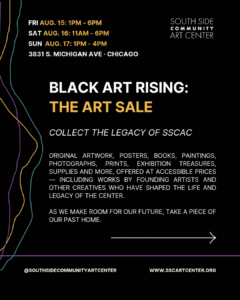
Black Art Rising: The Art Sale

August 15 @ 1:00 pm - August 17 @ 4:00 pm

COLLECT THE LEGACY OF SSCAC

Honoring Our Legacy | Building Our Future


Friday, August 15:
 1:00 PM – 6:00 PM
Saturday, August 16: 11:00 AM – 6:00 PM
Sunday, August 17: 1:00 PM – 4:00 PM

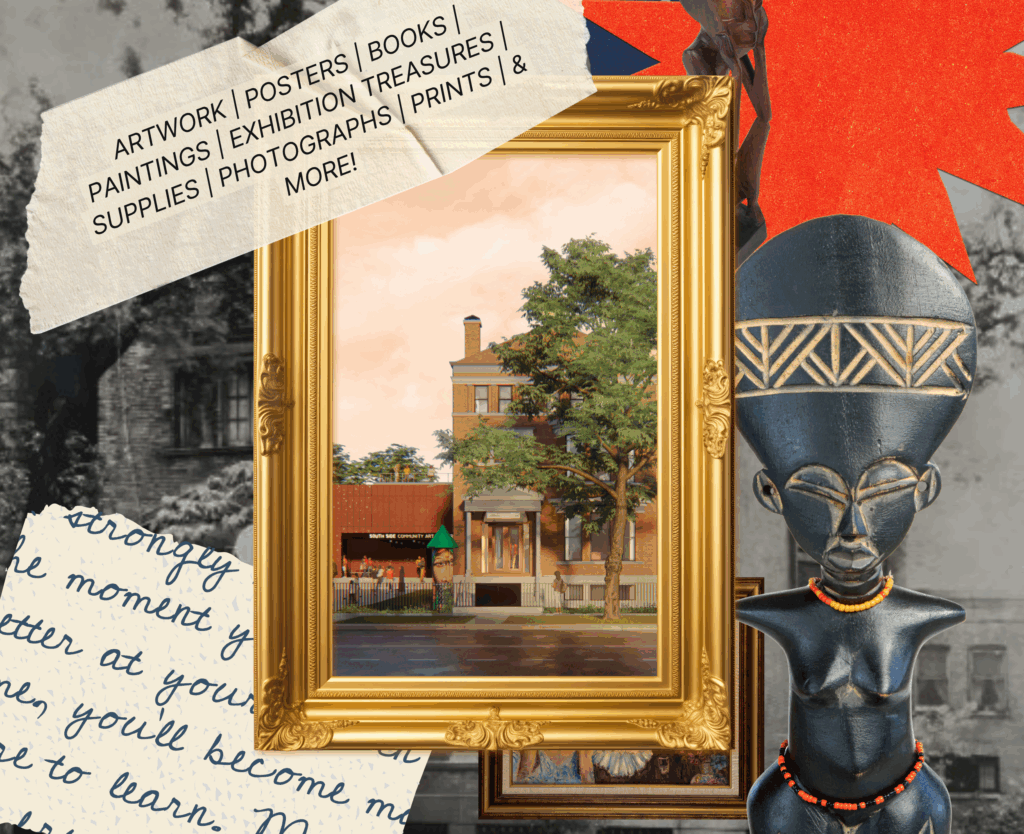
As we make room for our future, take a piece of our past home. From original artwork and archival prints to books, posters, studio supplies, and rare objects from past exhibitions, Black Art Rising: The Art Sale offers a rare opportunity to take home a piece of the Center’s living history. This also includes exhibition treasures and supplies that have supported decades of creativity at 3831 S. Michigan Ave.

Whether you’re a seasoned collector or simply want to bring a story home, each piece has been priced with care and intention. Some works were made within these walls. Others have lived here for years. All carry the spirit of Black art on the South Side.

This sale also marks a transition. As we prepare for the renovation and expansion of our historic landmark building, every purchase fuels the future through our Black Art Rising Capital Campaign.

Come browse, celebrate, and collect. Let’s make space together for what’s next.

Save the Date!
art sale info

South Side Community Art Center

3831 S Michigan Ave
Chicago, IL 60653 United States

MIXED MEDIA AND STILL LIFE

Works in EMERGENCE are diverse in their subject matter and media, but a few themes reappear throughout. Working in abstraction or in the traditionally peaceful genre of still life, artists like William Carter, Allen Stringfellow, and Jonathan Green express themes of interiority or sociability, history or modernity. Notably, Stringfellow and Ralph Arnold both experimented with media and materials and worked extensively in collage, which allowed them to combine abstract design, figurative imagery, and on occasion political ideas.

Viewers typically expect Black artists to focus on particular aspects of their social and political identities within their work. Where might those expectations come from? Still life, abstraction, and collage may express many different things about artists’ interior lives and their visual and social observation, whether connected to public manifestations of identity or not.

William Carter’s mid-century still life Untitled presents a group of vibrantly colored bottles that invite the viewer’s gaze, set against a similarly colorful background with floral elements like grapes and leaves. They give evidence of conviviality and might be interpreted as symbols of social gatherings, but they could also just be a collection of pleasing forms. We might put Carter’s still life in dialogue with that of Jonathan Green, who became close friends with Carter while living in Chicago. Green’s close-up view of an eloquently simple composition presents oranges, a pear, and a lemon in front of two vessels. Works like this piece call the viewer to examine the objects the artist chose to include, to consider how they interact with each other like bodies in space, and to reflect on their meaning within the traditional genre of still life painting.

Collage might suggest the piecing together of identity from different components that might not usually coexist, giving room for more expansive imaginations of meaning than a straightforward representational image might allow. It could also just be an inventive way of combining colors, shapes, and textures. Allen Stringfellow’s Untitled, a collage from 1962, brings familiar motifs from still life—fruit and flowers, desserts and glassware—together with imagery of artist’s models and performers. Layered with paint and tissue paper that frustrate the viewer’s attempt to get clarity on the subject matter, the bursts of form and colors hint at the splashy abstraction of Stringfellow’s untitled, textured painting made from house paint and particulate on cardboard. Here the artist tests commonly found materials to create new textures and plays with the creation of colors and finishes that diverge from “Western” academic painting methods.

In The Waiting, Arnold constructs a large collage from different paper components, lace, and paint. In the piece, elements of European and African art are placed in dialogue with one another, while some figures appear alone and isolated, others in large groups. Without giving easy answers, Arnold implies questions about social issues. Who is waiting, and for what? In his Love Sign II, which bears the words “Love is Universal,” Arnold asserts the equal validity of all types of romantic affection and love, utilizing collage to convey a more straightforward political message.